
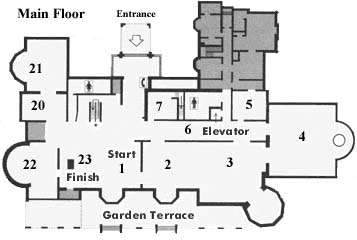
Great Hall (1)
This grand room, with its 60-foot high laminated oak-beamed ceilings and 40-foot high bay window with 783 lights of glass, was the focal point of elegant entertaining, however it was never fully completed. Sir Henry ran out of funds before the work was finished. The wall paneling was put in after he left and the fireplace was moved from the dining room. An organ, installed in 1924, was later sold. A Wurlitzer Organ, originally built for Shea's Theatre in Toronto and also used in Maple Leaf Gardens, was brought to the castle by the Toronto Organ Society and installed in 1972.
Throne (23)
The throne in this room is a replica of the Westminster Coronation Throne on which kings and queens of England are seated for their coronation ceremonies. The stone at the base of the throne represents the Stone of Scone used for similar coronation ceremonies for Scottish Kings, prior to the Union of Scotland and England in 1603. The chair was made for the Independent Order of Foresters who donated it to the Royal Ontario Museum and loaned it to the castle.
Billiard Room (21)
When Sir Henry lived in the castle the billiard table may have been located on the second floor in what is now Lady Pellatt's suite. From this room you can look northwest to see Sir Henry's summer home and see the route of the tunnel. Looking to the left you can see the architect E.J. Lennox's home, some say made from the profits on constructing the castle and even using some of the same material.
Study (7)
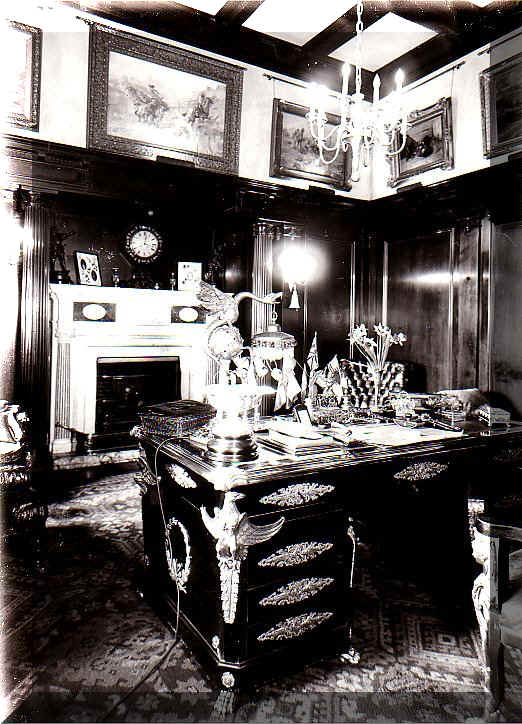
One of the smallest rooms in the house is Sir Henry's office, small but outfitted with a grand desk decorated with a dragon figured lamp and, like the stables, surrounded by seven foot high panels of Spanish mahogany. It was strategically located with a doorway leading directly to the outside and two private stairways, one leading to the second floor and access to Sir Henry's bedroom and the other to a vault and wine cellar. A special electrical heating apparatus was set up beneath the floor to keep Sir Henry warm while he worked at his desk.
Elevator
The Otis elevator was one of the few in North America to be installed in a home and probably the first to be installed in a home in Toronto. It was primarily for the use of Lady Pellatt, who was a semi-invalid. The elevator was rebuilt in the early 1980s for about $100,000 and returned to service.
Serving Room (5)
This small room next to the kitchen was designed at first as the breakfast room, but later turned into the serving room. It now displays an oak dining room suite given to Sir Henry by King Edward VII in 1902.
Peacock Alley (6)
This long alley, often used in films, was modeled after Peacock Alley in Windsor Castle. The walls are of quarter cut oak and floor of Burmese teakwood, two and a half inches thick, secured and held together by mahogany strips and rosewood wedges. No nails were and could be used in the floors because the wood was resting on a base of eight inches of solid concrete.
Palm Room / Conservatory (4)
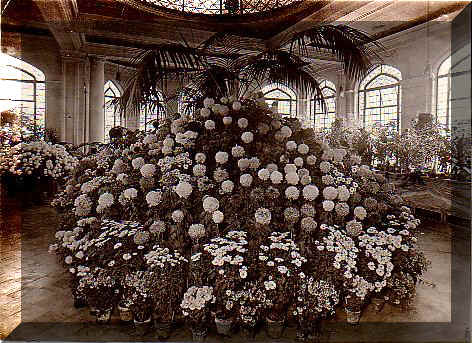
This room was a great place to display plants throughout the year and is a good site for displays and presentations. Its theme is of a Mediterranean courtyard with a grape and vine design on the Italian stained glass dome which was backlit by some 600 lights and cost about $12,000 at the time of construction. The flower beds, or ferneries, on each side of the room are heated by a system of steam pipes and these ferneries were often replanted with whatever was in bloom at the time. The floor was covered in Italian marble that is so smooth it looks wet. The side panels are of marble from Bancroft, Ontario and the design seems to emulate the topography of the country.
Bronze Doors
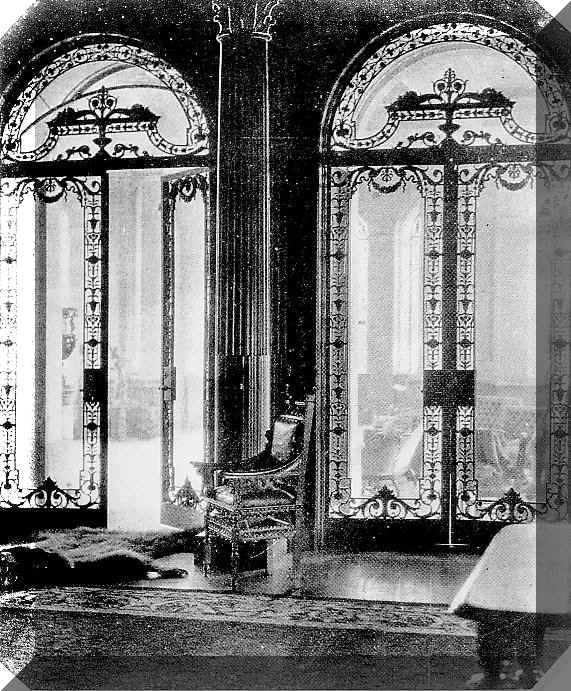
Copies of doors made in New York around 1911 for an Italian villa, each cost more than $10,000. In spite of their weight they are perfectly balanced and can be moved with a finger touch. The one-quarter inch plate glass swings free so it can be easily cleaned.
Dining Room (3)
At least one hundred guests could be seated and served in this room, surrounded by Circassian walnut. When the castle was operated as a hotel in the late 20s, the wall was removed and opened up to the library.
Library (2)
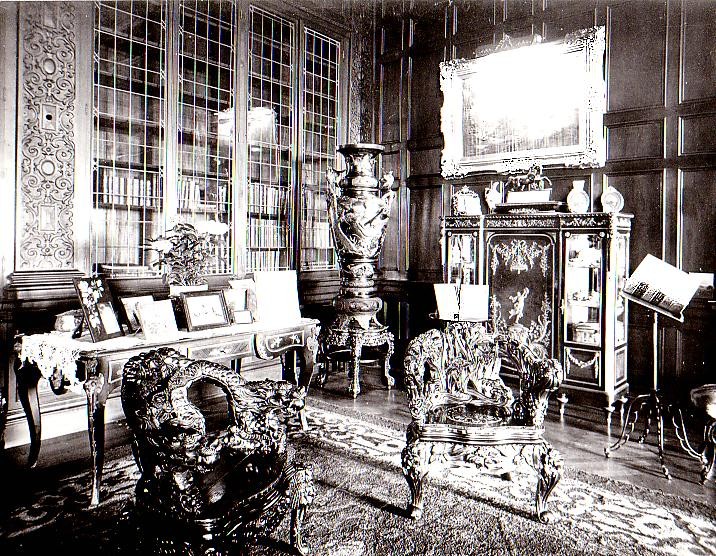
This room may have been the heart of the castle. Here the Pellatts greeted and entertained guests. At its prime it contained a collection of ornate and gilded furniture, Chinese vases, Indian rugs, a bear rug and a select collection of leather-bound books. Those books were sold when the assets of the castle were sold and the books shown today are merely ornamental. The floor is constructed in a herringbone pattern made by splitting single pieces of Canadian oak in half and butting the ends. Thus the shading differs depending on which end of the room you face. The Pellatt coat of arms is molded into the ceiling and carried the family motto: Devant Si Je Puis: Foremost If I Can.
Napoleon Drawing Room (22)
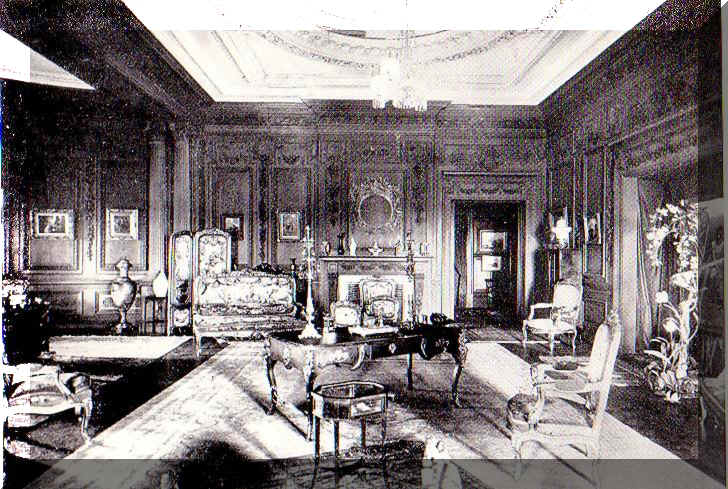
Sir Henry was a fan of Napoleon's military prowess and this room was outfitted with period pieces. Of special note is the plaster ornamentation on the ceiling, molded by Italian artisans, with lightbulbs hidden behind the plaster, so as to indirectly illuminate the ceiling. The limewood paneling, with crested and golden pheasants holding onto bunches of fruit and grapes, took two years for the famed Martyn and Company of London, England, to carve. They were first displayed in a Montreal gallery in 1913 before being sent on to Toronto.